Everything included in a KitchenWebStudio website

Every feature of a KitchenWebStudio website for ghost kitchens, commissary kitchens, catering kitchens and multi-brand operators, and which of the three plans carries it.

Pages that open instantly

Custom-coded pages served from the edge, 90+ PageSpeed on every tier.

Why a kitchen site needs to load faster than a delivery app

A customer deciding between your brand and the next one in a delivery app is not going to wait for a slow page. Every page on your site is custom coded, ships almost no JavaScript, and is served from Cloudflare's global edge network, so it opens the same instant whether someone finds you through a Google search, a QR code on packaging, or a link from a delivery platform. There is no plugin stack to slow down over time and no theme update that quietly breaks the checkout link.

What this looks like during a rush

A ghost kitchen or catering operation gets traffic in bursts, around meal periods, around an event date, around a marketing push. The site is built to hold up under that kind of spike without you doing anything, because it is not running a database query per visitor the way a page-builder site does. If a station is running behind and you need to update a cutoff time or pause online ordering for a brand, that page still loads instantly for everyone checking it.

Available on: The Line, The Pass, Head Chef

One site, every brand you run

A page for each virtual brand operating out of your facility, all under one domain.

What a multi-brand page structure gets you

Each virtual brand you run out of your kitchen gets its own page with its own name, its own menu, its own photos, and its own delivery links, while the whole set lives under one domain you control instead of scattered across marketplace listings. A visitor lands on the brand they searched for, not a generic facility homepage, and search engines can index each brand separately instead of treating your operation as one blurry entity.

Adding or retiring a brand

Launching a new concept or shutting one down is common in this business, and the site is built so that is a revision, not a rebuild. A new brand page goes up with its own menu and delivery links inside your standard turnaround. A retired brand comes down cleanly, with its links redirected so nothing on a delivery platform points at a dead page. You are never locked into the brand lineup you had on day one.

Available on: The Line, The Pass, Head Chef

Delivery platform links, organized by brand

DoorDash, Uber Eats, Grubhub and more, linked correctly under each brand.

Where a customer actually orders

Most ghost kitchen orders complete on a third-party platform, not on your own site, and the job of this page is to get the right customer to the right platform link for the right brand without confusion. Each brand section lists its live delivery platform links, so a customer who wants your food through DoorDash, Uber Eats or Grubhub gets there in one tap instead of searching the platform themselves and possibly landing on a competitor.

Keeping links current across every brand and platform

Delivery platform links change more often than most site content: a brand goes live on a new platform, an old listing gets deprecated, a promo link needs swapping in for a season. Any of that is a standard revision through your client portal, turned around in your plan's turnaround window. You send the new link and which brand it belongs to, and it is live without you touching a website builder.

Available on: The Line, The Pass, Head Chef

Catering inquiry and quote-request forms

A form built around event date, guest count and menu, not a generic contact box.

What the form actually asks for

A catering inquiry needs an event date, a guest count, a menu direction and a delivery or pickup preference before anyone on your team can quote it, so that is what the form collects instead of a generic name-email-message box. The inquiry lands wherever you tell us to send it, whether that is an inbox, a shared calendar, or your CRM, formatted so your team can see at a glance whether the date and headcount are even feasible before picking up the phone.

Any quote shown on the page is illustrative only

If your catering page shows a starting range or a per-person estimate to help a prospect self-qualify, it is clearly labeled as an illustrative starting point, not a binding quote, and the form itself makes clear that final pricing comes from your team after the details are confirmed. We never build a page that commits you to a number before you have reviewed the order, and we never advise on what to charge, that is entirely your call.

Available on: The Line, The Pass, Head Chef

Commissary and shared-kitchen listing page

A page built to fill open stations, with tour requests routed to you.

What tenants see when they land on this page

A prospective tenant looking for kitchen space wants to know what is available, what it costs to find out more, and how to see the facility before committing. This page presents your available stations, storage and equipment in plain operational language, states your general terms without locking you into a rigid rate table that goes stale, and puts a tour-request path front and center so a serious lead reaches you rather than bouncing to the next listing they find.

Keeping availability current without a rebuild

Station availability shifts as tenants sign and leave, so this page is built to be updated as a revision: mark a station as taken, add a new one when you expand, adjust the equipment list, all inside your plan's standard turnaround. On tier two and three, an inquiry about touring the space can be picked up automatically by the AI Engine and routed to your calendar, so a lead that comes in overnight is not sitting untouched until morning.

Available on: The Pass, Head Chef

Location and delivery-area pages

Clear pages for your facility address, service radius and pickup details.

What a location page needs to say

A location page states where your facility operates from, what delivery radius or service area each brand covers, and whether pickup is available, so a customer or a search engine does not have to guess. This matters for both people and platforms: search engines use this page to understand where you actually serve, and customers use it to check before they place an order that will only get canceled for being out of range.

Multiple facilities or expanding service areas

If you operate from more than one facility, or expand a delivery radius as you add drivers or platforms, each location gets its own page rather than one page trying to describe several addresses at once. Updating a delivery radius, adding a new facility, or narrowing a service area during a slow season is a standard revision, turned around within your plan's window.

Available on: The Line, The Pass, Head Chef

Managed hosting and security

Hosting, SSL, backups and uptime handled, with nothing billed separately.

What "managed" covers

Hosting, SSL, backups and day-to-day security monitoring are handled as part of your plan, included in the one monthly fee with nothing billed separately later. The site runs on Cloudflare's global network, which means DDoS protection and unmetered bandwidth are built in rather than sold as an upgrade. You are not the one renewing a certificate, patching a plugin, or fielding a hosting company's upsell email between shifts.

What you do when something needs attention

If anything about the site needs a look, you raise it in your client portal and it is handled by the team that built the site, not a ticket queue at a hosting company that has never seen your brand. You never need your own login to a server or a website admin panel. That separation is deliberate: you run the kitchen, we keep the site up.

Available on: The Line, The Pass, Head Chef

Client portal and revisions

Request changes, track them and message the team, all in one place after launch.

What the portal is for

The client portal is your account with us, and you get access the day your site goes live. Every request after that runs through it: a new brand page, an updated menu, a changed delivery link, a swapped photo. You describe the change, attach whatever we need, and it becomes a tracked request instead of a message that gets buried in an inbox during a busy shift. Revisions included in your plan are turned around within your plan's standard window, and you can see exactly where each one stands.

What happens past your included revisions

Every plan includes a set number of revisions each month, and there is no limit on the size of a single revision, so a request covering several changes at once still counts as one. Once you go past the included amount for the month, each additional revision is billed at a flat rate rather than by the hour, so there is never a guessing game about what a change will cost before you ask for it.

Available on: The Line, The Pass, Head Chef

The AI Engine

Automated inquiry intake, messaging and tour booking, handed to a person for anything sensitive.

What the AI Engine handles

On The Pass and Head Chef, the AI Engine picks up incoming inquiries the moment they arrive, whether that is a catering request, a commissary tour inquiry, or a general question about a brand, and responds immediately instead of leaving a lead waiting until someone checks email. It can answer questions about your menus, delivery areas and availability, hold a conversation with a prospect, and book a tour of your facility directly onto your calendar, all while you are running the line.

What it will never do

The AI Engine never gives food safety, allergen or nutrition advice, and it never makes a licensing or compliance claim on your behalf. The moment a conversation touches any of that, it hands the customer to a person on your team rather than guessing at an answer. We build and manage the website and its automation, we are not a food safety consultant or a licensing authority, and the AI Engine is built to respect that line every time, not just when it is convenient.

Available on: The Pass, Head Chef

The Content Engine

Researched articles published every week, written for your kitchen operation.

What gets published

On Head Chef, researched articles are written and published to your site every week, each one running 2,500 to 3,200 words and grounded in real research rather than filler generated to hit a word count. Topics are pulled from what people running or ordering from kitchens like yours actually search for: how a virtual brand model works, what a commissary tenant should know before signing, how catering minimums typically get structured. Nothing gets invented to sound impressive; a claim either has a real source or it does not appear.

Why this matters for a kitchen operation with no time to write

Most kitchen operators do not have a spare hour between prep and service to write search-optimized articles, and content that never gets published cannot bring in search traffic. The Content Engine removes that bottleneck entirely: articles are researched, written, checked and published on a standing weekly cadence without you drafting anything, so your site keeps growing its footprint in search results while you stay focused on the kitchen.

Available on: Head Chef

The full tier matrix

FeatureThe LineThe PassHead Chef
Pages that open instantly
One site, every brand you run
Delivery platform links, organized by brand
Catering inquiry and quote-request forms
Commissary and shared-kitchen listing page
Location and delivery-area pages
Managed hosting and security
Client portal and revisions
The AI Engine
The Content Engine

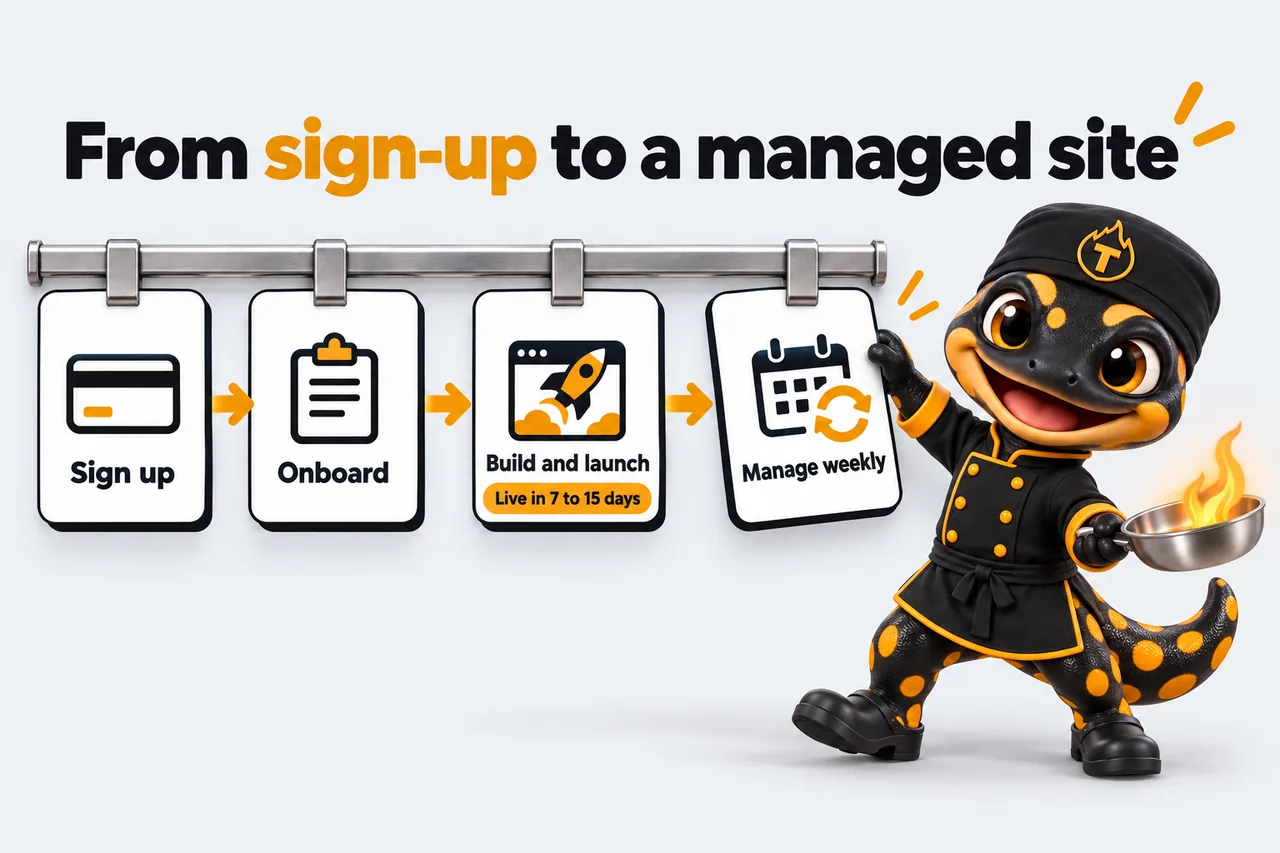
From sign up to a managed site

  1. 01

    Sign up

    Choose a plan, pay the first invoice.

  2. 02

    Onboard

    Form plus one call, about 15 minutes total.

  3. 03

    Build and launch

    Live in 7 to 15 days.

  4. 04

    Manage weekly

    Updates, revisions and articles keep moving.

Questions about the AI Engine and articles

How many articles get published, and how long are they?

2 researched articles a week on The Line and The Pass, and 3 a week on Head Chef, each one 2,500 to 3,200 words. They are written for people actually searching around your kind of operation, virtual brand models, commissary tenancy, catering logistics, not filler generated to hit a word count.

Do the researched articles need review before they publish?

No, they publish on the standing weekly schedule without you drafting or approving each one first, since most kitchen operators do not have spare time between prep and service for a review cycle. If an article needs a change after it is live, whether that is a correction or a different angle, that is a standard revision through your portal.

Will an article ever give food safety or allergen advice?

No. Articles are researched and written around topics like operations, delivery logistics and the business side of running a kitchen, never food safety, allergen or licensing guidance. We are not a food safety consultant or a licensing authority, and every claim in an article either has a real cited source or does not appear at all.

What does the AI Engine actually do for a kitchen?

On The Pass and Head Chef, the AI Engine picks up incoming inquiries the moment they arrive, whether that is a catering request, a commissary tour request, or a general question about one of your brands, and responds immediately. It can answer questions about menus, delivery areas and availability, hold a conversation with a prospect, and book a facility tour directly onto your calendar, all without someone on your team stopping mid-shift to reply.

Can the AI Engine tell a customer about allergens?

No. It never gives food safety, allergen or nutrition advice under any circumstance. The moment a conversation touches any of that, it hands the customer to a person on your team rather than guessing at an answer. We build and manage the website and its automation; we are not a food safety consultant, and the AI Engine is built to respect that boundary every time.

Does the AI Engine work across all our brands at once?

Yes. It is trained on every brand, menu and facility detail you provide at onboarding, so it can answer a question about any of your virtual brands or units without you configuring a separate assistant for each one. When you add a new brand, its menu and details are added to what the AI Engine already knows as part of that revision.

See every feature in action

A live walk-through, on your screen, in about 30 minutes.

Book a demo