For ghost kitchens, commissary and catering operations

A website built for how a working kitchen actually runs

A managed, custom-coded website for ghost kitchens, commissary kitchens, catering operations and multi-brand kitchen groups: fast pages, weekly updates, researched articles, an AI receptionist and hosting included, from one monthly fee.

$647 build fee invoiced after launch. Live in 7 days. 5 revisions a month included.

Thyme, the salamander chef mascot, waving from a kitchen pass and turning a tablet toward you that shows a website layout
PASS / LIVE ORDERS
Brand A, Order 118Firing
Brand B, Order 119Expedite
Brand C, Order 120Out the door
Catering, Order C-04Prep

7 days

To a live site on The Line

5

Revisions a month included

90+

PageSpeed on every page

3

Researched articles a week on Head Chef

What a bad site actually costs a kitchen

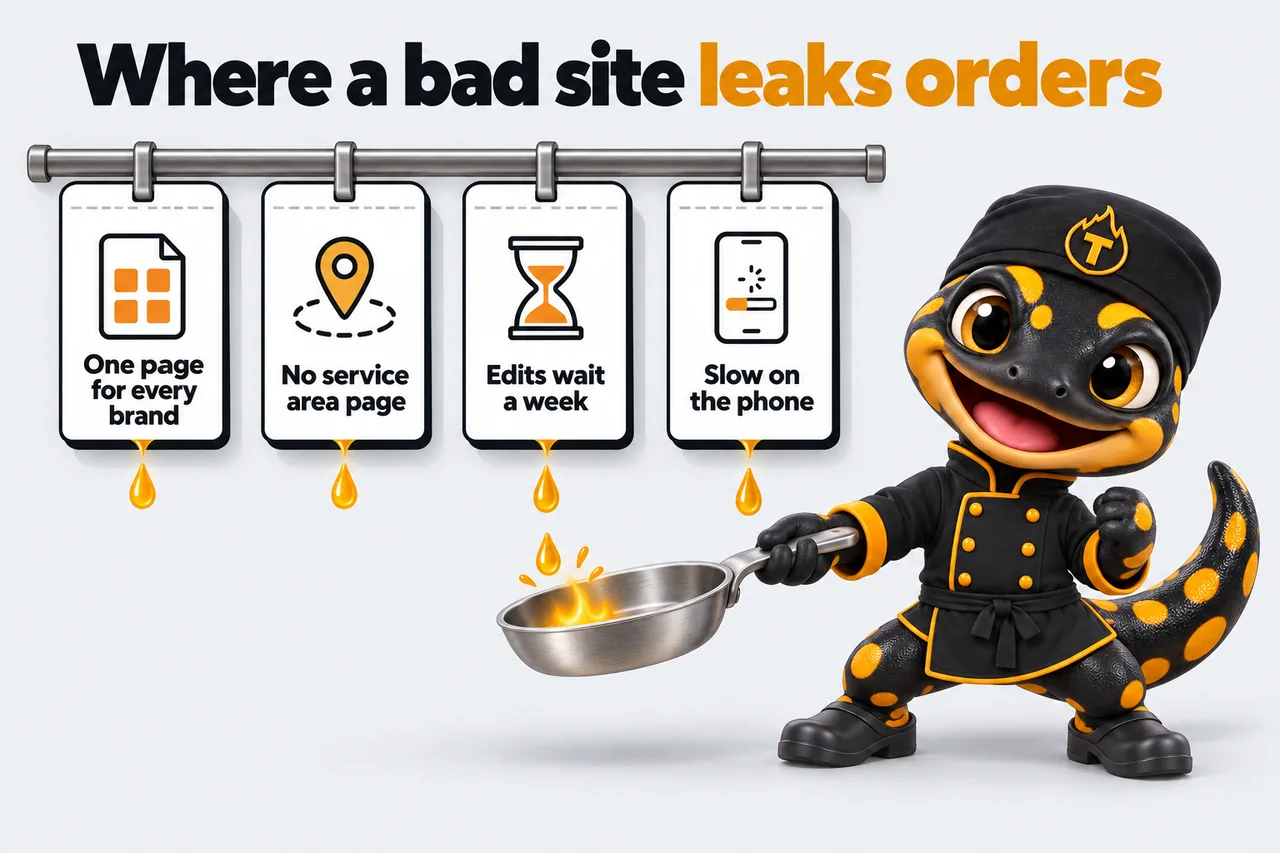
A ghost kitchen, commissary or catering operation does not lose business to a bad website in one dramatic moment. It leaks a few orders a week, quietly, to whichever platform listing loaded faster.

Where a bad site leaks orders: One page for every brand; No service area page; Edits wait a week; Slow on the phone. Thyme catches the leaking orders in his pan.
  • One page trying to sell four brands

    A single generic page cannot answer for a poke brand, a wing brand and a dessert brand at once, so search engines and customers both default to whichever platform listing shows up first.

  • No real service area page

    A facility that only delivers still needs a page that states its coverage plainly, or it keeps losing searches to a competitor who bothered to write one.

  • Edits take a week and an invoice

    A menu changes, a brand launches, a delivery radius shifts, and the site cannot keep up because every change goes through a freelancer with a queue.

  • It is slow on the phone it is judged on

    Almost everyone who finds a delivery-only kitchen does it on a phone between other things, and a slow page loses them before the menu even renders.

What leaving it alone actually costs

A bad website does not fail loudly. It leaks: a few orders, a few searches, a few inquiries a week, in ways that never show up on a report.

  • Orders that were already paid for

    Every visitor who arrives from an ad, a QR code on packaging or a link in a bio cost you something to get there. A page that loads slowly, or that answers for the wrong brand, spends that money and returns nothing. The loss is invisible because nobody reports the order that was never placed.

  • Searches that go to whoever wrote the page

    A customer searching for the cuisine you sell in the neighbourhood you deliver to finds whichever kitchen bothered to publish a page about it. If that page does not exist on your domain, the search does not fail. It just resolves somewhere else, week after week.

  • Catering inquiries that arrive unqualified

    A generic contact box produces a name and a sentence, which means a call, an email and a follow-up before anyone knows whether the date is even free. Inquiries that take three days to qualify are inquiries a faster caterer has already quoted.

  • Stations sitting empty while tenants look elsewhere

    Nobody rents a commissary station from a page that does not say what is available. The cost of an idle station is the same whether the reason is the market or a stale website, and only one of those is fixable this week.

  • A presence you do not own

    A platform listing can change its rules, its ranking or its fees without asking you. If the listing is the only place your brands exist, you are renting your entire customer relationship from a company whose interests are not yours.

  • The owner hours spent on it anyway

    The site still takes time. It takes it in the evenings, in fragments, badly, on a laptop after a fourteen hour day. That is the most expensive way for a kitchen to do web work, and it is what happens when nobody else is responsible for it.

Most of this is a build decision, not a marketing budget

A page per brand, a real service area page, forms that qualify, and changes that land within 2 to 5 working days instead of waiting for a free evening.

See it fixed on a demo

Built for every line in the building

Ghost kitchens Commissary kitchens Catering kitchens Multi-brand groups Delivery-only brands Event production kitchens Shared-use facilities Meal prep operations

The site runs like a pass line

Station to station, left to right, the same order an order actually travels through a working kitchen.

Everything a kitchen site needs, nothing it does not

Every plan runs on the same fast build. Two features step up on The Pass and Head Chef, marked below.

  • Pages that open instantly

    Custom-coded pages served from the edge, 90+ PageSpeed on every tier.

  • One site, every brand you run

    A page for each virtual brand operating out of your facility, all under one domain.

  • Delivery platform links, organized by brand

    DoorDash, Uber Eats, Grubhub and more, linked correctly under each brand.

  • Catering inquiry and quote-request forms

    A form built around event date, guest count and menu, not a generic contact box.

  • Commissary and shared-kitchen listing page

    A page built to fill open stations, with tour requests routed to you.

    The Pass and up
  • Location and delivery-area pages

    Clear pages for your facility address, service radius and pickup details.

See every feature and the full tier matrix

A faster page makes your advertising cheaper to run

Not a promise of a number. A mechanism, and it works in your favour in three separate places.

  1. 01

    You keep more of the clicks you already bought

    Every visit from an ad, a boosted post or a link on your packaging is paid for before the page opens. A page that renders instantly keeps those people; a slow one loses a share of them while they are still looking at a blank screen. That is the cheapest traffic you will ever recover, because you have already spent the money.

  2. 02

    Ad quality takes the landing page into account

    Google Ads assesses ad quality partly on landing page experience, which covers how relevant and useful the page is and how easily people can find what they came for. A better landing page experience can lower what you pay for a click. Nobody can tell you how much, and anyone quoting you a percentage is guessing.

  3. 03

    The same page works when you are not paying at all

    A fast, well-structured page keeps earning from search, from brand-name lookups and from AI assistants quoting your pages long after a campaign ends. Speed is one of the few investments here that pays into both the paid and the unpaid side of the same account.

How a fast page pays back: 90+ PageSpeed; Keep the clicks you paid for; Better landing page experience; Keeps earning from search. Thyme runs along the chain pointing ahead.

The search work, explained as what you get

Three acronyms get used constantly and explained rarely. Here is what each one means on your site, and what it is not.

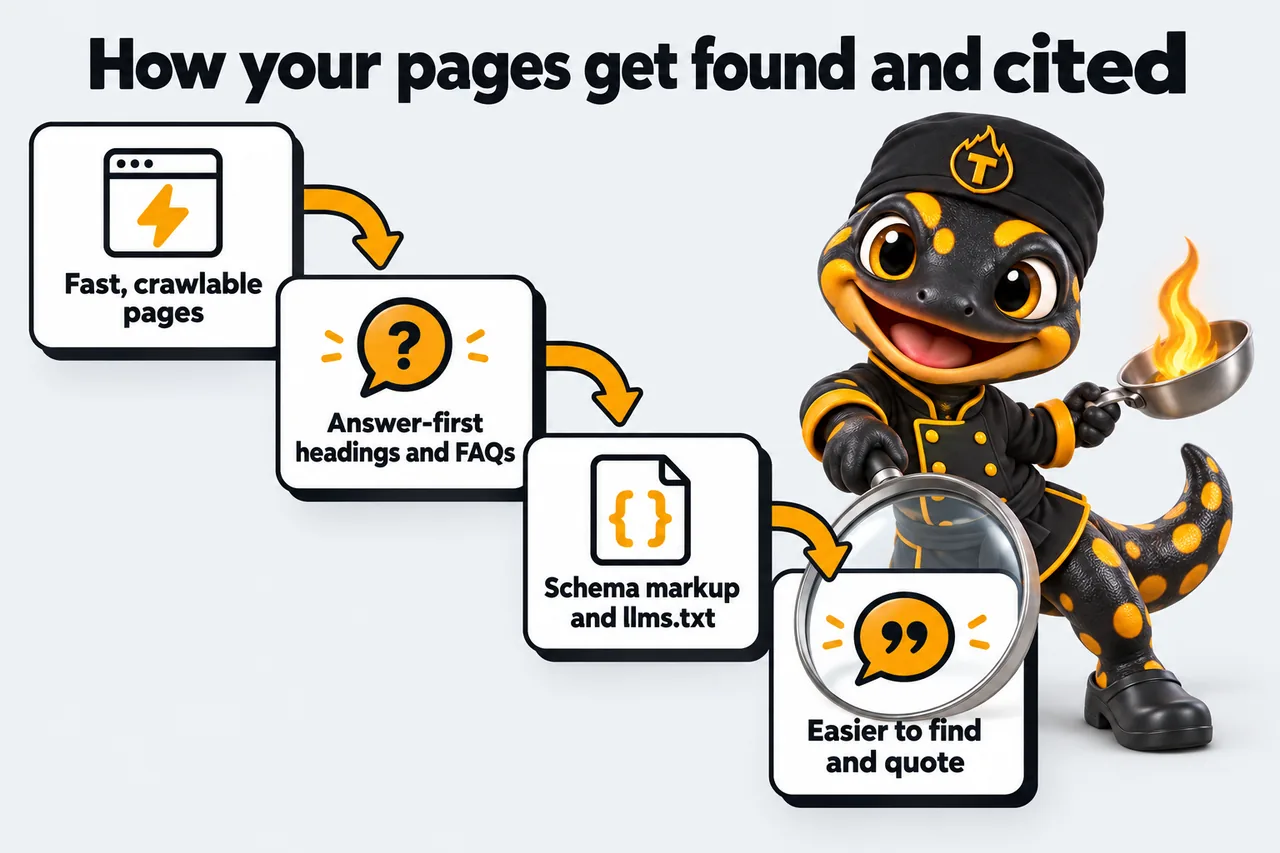
How your pages get found and cited: Fast, crawlable pages; Answer-first headings and FAQs; Schema markup and llms.txt; Easier to find and quote. Thyme holds a magnifying glass over the last step.
  • SEO

    Being found in search

    The technical build plus a page for every place and service you sell.

    • Pages that load fast, are crawlable without JavaScript and have clean, readable URLs.
    • A page per virtual brand, so each concept can rank on its own name instead of competing with its siblings.
    • A page for each town, city or delivery zone you actually serve, written from what you tell us at onboarding, never a template with a place name swapped in.
    • Titles, descriptions, headings and internal links set as each page is written, with old URLs redirected when you migrate.
  • AEO

    Being the answer, not just a result

    Content shaped so a search engine can lift the answer straight out of it.

    • Every section opens with a direct answer to the heading above it, then expands.
    • Headings phrased the way an operator or a customer actually asks the question.
    • A page-specific FAQ block, visible on the page and marked up so it can be used for a rich result or read aloud by a voice assistant.
    • Comparison tables and short definition blocks written to be extracted whole rather than paraphrased.
  • GEO

    Being cited by AI assistants

    Assistants like ChatGPT, Claude, Perplexity and Google AI Overviews summarise pages they can parse and trust.

    • An llms.txt and a full-content file describing what your operation is, where it works and which pages matter.
    • Consistent entity naming: the same business name, brand names and service names on every page.
    • Facts stated plainly and dated, so a claim is quotable rather than buried in adjectives.
    • No guarantee of appearing in any AI answer. What we do is remove every technical reason to skip you.
  • Schema

    Structured data, in plain words

    A block of machine-readable facts attached to each page, generated from what the page already shows.

    • Organization or LocalBusiness markup describing the business and the area it serves.
    • Service markup on each service page and FAQPage markup wherever questions are answered on screen.
    • BreadcrumbList so a search result can show where the page sits in your site.
    • Review markup only ever from reviews that are genuinely yours, never from examples written for you.

See the full search, answer engine and schema breakdown

What changes when the site is actually managed

The same five things, before and after, in plain terms.

  • Brand pages
    Before:One page trying to represent every virtual brand at onceAfter:A dedicated page per brand, each with its own menu and photos
  • Service area
    Before:No stated coverage, so search engines guessAfter:A clear service area page naming the zones actually delivered to
  • Edits
    Before:A menu or hours change waits on a freelancer’s queueAfter:Moves in 2 to 5 working days through the client portal
  • Speed on a phone
    Before:Heavy page builder plugins slow the one screen it is judged onAfter:90+ PageSpeed on every page, phone included
  • Enquiries
    Before:Land in a platform inbox the kitchen does not fully controlAfter:Route straight into the kitchen’s own CRM by API, Zapier or Make

Three plans, one build fee charged after launch

$647 one-time, invoiced only once the site is live and approved. No fourth tier, no add-on tier.

  • The Line

    The website, fully managed

    $117/ month

    The build, managed, with weekly updates and hosting included.

    Live in 7 days

    See The Line in full
  • Head Chef

    Everything, plus the Content Engine

    $597/ month

    Everything on The Pass, plus a researched article three times a week.

    Live in 15 days

    See Head Chef in full

What each plan adds, feature by feature

Nothing is taken away as you move up. Each plan is the one before it plus the engine named on it.

  1. The Line

    $117/ month

    Everything on The Line

    The managed website itself: built, hosted, updated weekly and live in 7 days.

    • Pages that open instantlyA customer deciding between your brand and the next one in a delivery app leaves while a slow page is still loading, and every one of those is an order you already paid to reach.
    • One site, every brand you runEvery virtual brand you run gets buried on one shared page, so a customer searching for one concept lands somewhere that answers for four.
    • Delivery platform links, organized by brandA stale platform link sends a hungry customer to a dead listing, and nobody finds out until the order does not arrive.
    • Catering inquiry and quote-request formsInquiries arrive as a name and a vague message, so your team burns a day chasing the date and headcount before they can even quote.
    • Location and delivery-area pagesOrders get placed from outside your radius and then cancelled, and searches in the areas you do cover go to whoever bothered to state theirs.
    • Managed hosting and securityHosting, SSL and plugin upkeep are somebody's job, and in most kitchens that somebody is the owner at 11pm.
    • Client portal and revisionsA menu change waits in a freelancer's queue for a week, and by the time it lands the special is over.
    • Inquiries routed into your CRMInquiries pile up in a shared inbox nobody can open during a rush, so the biggest jobs are the ones most likely to go cold.
    • Search, answer engines and AI citationsSearch engines and AI assistants have nothing of yours to read, so they send people to a marketplace listing you do not control.
    • Policy pages and an accessible buildA kitchen site collects names, phone numbers and event details with no policy page, no real cookie consent and no accessibility statement behind it.
    • Migration, domain and a launch that keeps your links aliveRebuilding means old links break, and every dead link is a customer or a platform listing pointing at nothing.
    • 5 revisions a month, any size, completed within 2 to 5 working days
    • 2 researched articles a week, 2,500 to 3,200 words each
    • One domain included, registered in your name
  2. The Pass

    $247/ month + usage

    The Pass adds the AI Engine

    The part that answers while you are on the line, on the channels a kitchen actually gets contacted on.

    • Commissary and shared-kitchen listing pageOpen stations sit idle because nothing online says what is available, so word of mouth is doing all the selling.
    • The AI EngineAn inquiry that arrives mid-service sits unanswered until someone comes off the line, and the lead has already messaged two competitors.
    • AI receptionist, chat and text agentsCalls, chats and texts arrive during service, and by the time anyone gets to them the person has already messaged two other kitchens.
    • Carrier registration for business text messaging (A2P 10DLC) filed for you
    • You review every agent script before launch
    • Billed as $247 a month plus AI usage at what our providers charge us
  3. Head Chef

    $597/ month

    Head Chef adds the Content Engine

    The publishing cadence that keeps the site growing in search without anyone drafting a word.

    • The Content EngineNobody on a kitchen team has a spare hour between prep and service to write search content, so nothing ever gets published.
    • 3 researched articles a week instead of 2
    • Topics pulled from what people searching around your kind of operation actually ask
    • Live in 15 days once the first articles are queued

Every feature above says what it does, the problem it removes and what you have to do about it on thefeatures page, and the full tier matrix is there too.

What we put in writing, and what we do not

Two guarantees, one billing decision and one exit route. All four are in the terms, conditions included.

  • 90+ PageSpeed, guaranteed

    We guarantee a Google PageSpeed score of 90+ on mobile and desktop for the pages we build and host. If a page falls below that because of our work, we fix it at no charge.

  • Local search within 3 to 5 months

    We guarantee that your site starts ranking for local searches in your area within 3 to 5 months of launch. If it has not, we keep doing the search work at no additional charge until it does.

  • The build fee comes last

    The $647 one-time build fee is not taken at sign-up. It is invoiced only after your site is live and you have confirmed you are happy with it, which is the point of doing it that way.

  • No minimum term, and the domain is yours

    Plans run month to month with the notice period set out in the terms. Your domain is registered in your name, transfers free if you leave, and your content and articles are exported within 14 days.

The limits, stated here rather than buried

  • Neither guarantee covers changes you or a third party make, or content you ask us to publish against our advice.
  • The ranking guarantee is about local searches in your area and your services, not any term you choose.
  • Neither guarantee entitles you to a refund. The remedy is the corrective work described above.
  • All sales are final: monthly fees, the build fee and extra revisions. The exception is a duplicate or incorrect charge by our billing, which we correct.
  • Revisions past the 5 included each month are a flat $20 each, never hourly, and unused revisions do not roll over.

Read the full terms or the refund position before you buy, not after.

Before you look at the price

What operators say the managed plan changed, in their own operational terms.

Order noteNo. 201

“The commissary kitchen tours preparation page does one job and does it well. Visitors arrive knowing what the first discussion covers and what they should think about beforehand. The link now goes out with our reply to every new inquiry.”

Cecil Satterfield, Kitchen manager
Hourly commercial kitchen hire facility, Green Bay, WI
Preparation guide and inquiry support for commissary kitchen tours

Order noteNo. 202

“They pushed us to be precise about commissary kitchen tours, which felt slow at first and right at the end. The page describes the process faithfully and leaves the judgement calls to a conversation with our team. Correcting the site's accidental promises is no longer part of our calls.”

Irene Millington, Customer inquiries supervisor
Chilled prep and storage kitchen, Columbia, SC
Service scope and expectations for commissary kitchen tours

Order noteNo. 203

“The question 'who is answering this one?' used to hang over every commissary kitchen tours inquiry. Requests are assigned automatically, with a backup for when the owner is away. The website and our way of working finally match.”

Vasanth Wadhwa, Viewings administrator
Chocolate and patisserie kitchen hire, Akron, OH
Inquiry assignment and staff handover for commissary kitchen tours

Where we build, and why the state matters

KitchenWebStudio builds for kitchen operators across the United States. The work is remote, the onboarding call is on your screen, and the site is built around your facility, your delivery radius and the platforms you actually run on.

The state is not decoration on a page. A commissary in California is selling scarce space, a caterer in Florida is working a winter event calendar, a kitchen in Arizona is delivering across distances that make the coverage page decisive, and a Brooklyn operator is measuring a radius in blocks. Those differences change which pages your site needs first, and they are part of what we ask about at onboarding.

We build service area pages for the towns, cities and counties you serve, on your own domain. We do not build thin city pages on this site to catch searches we have no business answering.

Gloved hands lifting a stainless steel strainer over a prep station
  • TexasDense ghost kitchen clusters in Houston, Dallas and Austin, usually several brands per facility
  • CaliforniaCommissary and shared-use space at a premium, so available-station pages get read carefully
  • FloridaHeavy catering and event seasonality, with quote requests spiking around the winter calendar
  • New YorkSmall footprints, multiple virtual brands per kitchen, delivery radius measured in blocks
  • GeorgiaFast-growing delivery-only market around Atlanta with new facilities opening on short notice
  • IllinoisCommissary tenants moving between facilities, so tour requests decide who fills a station
  • ArizonaLong delivery radii, which makes a clear service area page the difference between an order and a cancellation
  • North CarolinaProduction kitchens supplying both retail and catering from one building
  • OhioMulti-unit operators running the same brands across more than one city
  • PennsylvaniaEvent catering with venue lists that need their own pages
  • WashingtonDelivery-first neighbourhoods where brand search happens before platform search
  • ColoradoShared kitchens renting by the shift, where availability changes week to week

Not on the list? We work with operators in every state. These are simply the markets where this kind of build comes up most.

How a build actually moves through the queue

Four steps, the same way an order moves: taken, confirmed, built, fired.

  1. You pay the first invoice

    That starts the plan. The build fee is not charged yet, and will not be until the site is live and you have approved it.

  2. You fill in the onboarding form

    Brands, menus, delivery platforms and service area, about 15 minutes. Anything missing can follow later without holding up the build.

  3. One onboarding call

    We walk through your answers, fill the gaps, and agree the launch date together.

  4. We build and launch

    Live in 7 days on The Line, sooner counted from onboarding, not from purchase.

Notes from the pass

20 kitchen teams on what changed after the build, in their own words.

Order noteNo. 101

“If you only look at the design you miss the best bit, which is the inquiry form. Every submission arrives with production type, equipment needs and preferred hours filled in, which used to take us a second email to obtain. It has quietly removed the slowest step in our intake.”

Alexa Brookfield, Bookings coordinator
Shared commissary kitchen, Omaha, NE
Inquiry form and response workflow for commissary kitchen tours

Order noteNo. 102

“My first check was simple: open the commissary kitchen tours page on a phone and try to get in touch. The important details sit near the top and the inquiry button is impossible to miss. Staff can now text a single link mid-call instead of narrating the menu.”

Nicholas Nightingale, Front desk coordinator
Meal prep production kitchen, Salem, OR
Mobile navigation and page layout for commissary kitchen tours

Order noteNo. 103

“They built the FAQ from our actual commissary kitchen tours correspondence. Each answer was reviewed by our own staff, so the page sounds like us rather than a copywriter. New starters read it too; it has become our reference, not just the customers'.”

Alison Rushworth, Office coordinator
Dark kitchen and prep space rental, Plano, TX
FAQ research and editorial review for commissary kitchen tours

Order noteNo. 104

“People used to call just to check their commissary kitchen tours form had actually gone through. The new confirmation states what happens next and how to amend anything that needs changing. It is a small corner of the site that makes the whole process feel finished.”

Martin Rothermere, Member services lead
Small-batch production kitchen, Overland Park, KS
Submission acknowledgment and follow-up for commissary kitchen tours

Order noteNo. 105

“The commissary kitchen tours preparation page does one job and does it well. Visitors arrive knowing what the first discussion covers and what they should think about beforehand. The link now goes out with our reply to every new inquiry.”

Cecil Satterfield, Kitchen manager
Hourly commercial kitchen hire facility, Green Bay, WI
Preparation guide and inquiry support for commissary kitchen tours

Order noteNo. 106

“They pushed us to be precise about commissary kitchen tours, which felt slow at first and right at the end. The page describes the process faithfully and leaves the judgement calls to a conversation with our team. Correcting the site's accidental promises is no longer part of our calls.”

Irene Millington, Customer inquiries supervisor
Chilled prep and storage kitchen, Columbia, SC
Service scope and expectations for commissary kitchen tours

Order noteNo. 107

“The question 'who is answering this one?' used to hang over every commissary kitchen tours inquiry. Requests are assigned automatically, with a backup for when the owner is away. The website and our way of working finally match.”

Vasanth Wadhwa, Viewings administrator
Chocolate and patisserie kitchen hire, Akron, OH
Inquiry assignment and staff handover for commissary kitchen tours

Order noteNo. 108

“Converting our commissary kitchen tours attachment into proper pages was overdue. The content is the same material, reorganized into headed sections that work on any screen. Nothing was taken away from the people who like paper.”

Huda Shalhoub, Intake coordinator
Farm shop production kitchen hire, Manchester, NH
Structured reference pages for commissary kitchen tours

Order noteNo. 109

“The audit found our commissary kitchen tours details repeated across several pages, each worded slightly differently. The facts have one home, and every change request names the reference page and its reviewer. It is the least glamorous work they did, and possibly the most valuable.”

Isaac Butterfield, Operations manager
Hot food production commissary, Fargo, ND
Content audit and update process for commissary kitchen tours

Order noteNo. 110

“The guided contact options looked like a small feature; they changed the inbox. New business and existing conversations now arrive under different subjects. Returning customers no longer repeat the whole form to ask one question.”

Beatrice Dalrymple, Customer care coordinator
Recipe development kitchen rental, Baton Rouge, LA
Inquiry categories and guided navigation for commissary kitchen tours

Order noteNo. 111

“The commissary kitchen tours page used to describe everything and route nothing. Each service description carries its own local contact, and the form inherits it. The 'let me transfer you' routine has almost disappeared.”

Louisa Saville, Commissary administrator
Street food prep commissary, Frederick, MD
Location information and contact routing for commissary kitchen tours

Order noteNo. 112

“I wanted the commissary kitchen tours page to show how we work, not just assert that we work well. Everything published is material we reviewed ourselves, chosen because it answers a real question. Visitors arrive having already seen how we operate, which shortens the first conversation.”

Jamila Abbas, Client onboarding lead
Licensed commercial kitchen share, Ann Arbor, MI
Reference content and service presentation for commissary kitchen tours

Order noteNo. 113

“The evening inquiry route for commissary kitchen tours suits how we actually work. Evening visitors leave structured information and an honest response time, nothing more promised. Mornings start with a proper queue rather than voicemail archaeology.”

Colin Blackwood, Scheduling coordinator
Weekend commercial kitchen hire, Omaha, NE
After-hours inquiry capture for commissary kitchen tours

Order noteNo. 114

“We approved the new commissary kitchen tours form only after trying hard to break it. The messages name the problem, and correcting a field no longer clears the rest. Staff demonstrating the form to a customer no longer have to apologize for it.”

Nigel Derby, Membership coordinator
Bakery production kitchen for hire, Salem, OR
Form usability and error handling for commissary kitchen tours

Order noteNo. 115

“Everyone talks about the new design; I cared more about where the old commissary kitchen tours links would land. The redirect plan was presented for our approval like any other deliverable. Not one 'your link is broken' message arrived after launch.”

Yvonne Fairchild, Tour appointments administrator
Food startup incubator kitchen, Plano, TX
Page migration and redirect mapping for commissary kitchen tours

Order noteNo. 116

“Requests to change the commissary kitchen tours page used to travel by hallway conversation. Now I send the current wording and its replacement, review the preview, and confirm. The follow-up email chains that used to accompany every edit have gone.”

Sophia Collingwood, Facility bookings coordinator
Vegan production kitchen share, Overland Park, KS
Content approvals and change requests for commissary kitchen tours

Order noteNo. 117

“Our follow-ups on commissary kitchen tours used to arrive disguised as brand-new inquiries. The two message types arrive under different subjects, so the sorting is done for us. Our inbox is easier to read, and their morning is easier too.”

Audrey Everhart, Operations supervisor
Catering prep kitchen rental, Green Bay, WI
Returning-customer contact path for commissary kitchen tours

Order noteNo. 118

“I never trusted pageview counts; what I wanted was to know where commissary kitchen tours inquiries began. It shows which page an inquiry started on, not merely how many people visited. Even the first weeks of data sharpened our discussions.”

Julian Selwyn, Business administrator
Overnight bakery kitchen share, Columbia, SC
Basic inquiry source reporting for commissary kitchen tours

Order noteNo. 119

“We asked about the bad day, not the good one: a failed commissary kitchen tours submission. The answer became a published fallback plus a delivery check we can run ourselves. Hoping the form never breaks is no longer the strategy.”

Gopal Sinha, Office manager
Food truck commissary base, Akron, OH
Contact resilience and delivery checks for commissary kitchen tours

Order noteNo. 120

“Previous projects left us a website and a memory; this one left instructions. There is a page inventory, update instructions, and named owners with backups. My cover used it while I was away and needed no extra explanation.”

Valerie Swindon, Site supervisor
Community commercial kitchen, Manchester, NH
Staff handover and maintenance notes for commissary kitchen tours

Does it pay for itself? Do the arithmetic with your numbers

We are not going to invent an average order value or quote an uplift percentage we cannot stand behind. The honest version is a worked example you finish yourself, with the only real figures being ours.

  1. What you pay

    $117 a month on The Line

    Plus a $647 one-time build fee, invoiced only after launch.

  2. What is inside that

    Build, hosting, domain, SSL, backups, monitoring

    Plus 5 revisions a month and 2 researched articles a week.

  3. What you would otherwise buy

    Builder subscription, hosting, a writer, a developer

    And the hours somebody spends stitching them together.

  4. What it has to return

    Your own break-even number

    One catering job, a filled station, or a handful of direct orders a week. You know which, we do not.

How operators usually run the numbers

A catering kitchen asks how many booked events a month cover the fee, and the answer is usually well under one. A commissary asks how many days of an empty station the fee equals, then how much sooner an availability page fills it. A ghost kitchen asks how many direct orders a week it takes, counting the platform commission it does not pay on an order placed through a link it controls. None of those sums need a statistic from us. They need your own average ticket, your own station rate and your own event margin, which you already know to the dollar.

The part worth adding to the sum is the time. Whoever currently maintains the site, writes nothing and fixes links at midnight is doing work that has a real cost, even when nobody invoices for it.

What this looks like six months from now

Not a promise about results. A description of what the service has actually been doing, week by week, by the time you stop noticing it.

  1. Week one

    The site matches the kitchen

    Every brand has a page with its own menu and its own delivery links, the service area is written down, and the catering or tour form asks for what your team actually needs. Live in 7 days from the onboarding call.

  2. Month one

    Changing it stops being a project

    A brand gets relisted on a platform, a menu changes for the season, a station frees up. You send a message from the portal and it is live within 2 to 5 working days. Nobody opens an editor and nothing waits for a Sunday evening.

  3. Month three

    There is content behind you

    Researched articles have been publishing every week since launch, so the site has depth around the things people search before they order or before they rent a station. None of them cost you a drafting session.

  4. Month six

    The site is doing work while you cook

    Inquiries route into your CRM with their details attached. On The Pass and Head Chef the AI receptionist answers the overnight ones and books tours onto the calendar. The pages that were written in month one are still fast, still correct and still yours.

Nothing in this section claims a revenue, ranking or order figure. Where a number appears, it is a term of the plan you can read in full on the pricing page.

A page builder site versus a managed one

The short version. The full 18-point comparison is on the pricing page.

WhatA typical page builder siteA KitchenWebStudio build
Build feePaid up front, whether the site works or not $647, invoiced only after you approve the live site
Hosting and domainBilled separately, often two different vendors Included in the monthly fee, one place, no surprise line item
SpeedWhatever a page builder theme happens to score 90+ PageSpeed guaranteed on every page
SupportA ticket number and a queue A client portal and a person who replies within one working day

See the full comparison table

The pages nobody wants to write, written into the build

Your site ships with the same policy set this one carries, and a consent banner that actually blocks something. This helps you meet what comes with running a public website. It is not legal advice.

  • Privacy policy

    What your forms collect, where it goes, who it is shared with and how someone asks for it to be removed. Written for your operation, not pasted from a generator.

  • Terms and conditions

    The terms a visitor agrees to by using your site, including anything specific to ordering, quoting or renting space that your operation needs stated.

  • Cookie policy with real consent

    A list of the cookies the site actually sets, and a banner wired to the scripts, so analytics and marketing tags do not fire until someone agrees.

  • Accessibility statement

    The standard the build was made against, what we did, and how a visitor reports a problem. Forms with real labels, keyboard operation, visible focus and readable contrast in both themes.

The kitchen-specific parts

  • Text messaging: where your plan includes the AI Engine, carrier registration (A2P 10DLC) is filed for you, and your forms carry the consent and opt-out wording your own messaging obligations require.
  • Allergen and food safety questions are always handed to a person. No page and no AI agent on a site we build answers them.
  • Claims about your permits, certifications, insurance or inspection status appear only as you supply them, and stay yours to keep accurate.
  • Any illustrative price, range or quote calculator is labelled as a starting point, never as a binding quote.

What we are not

KitchenWebStudio builds and runs websites. We are not a food safety consultant, health inspector or licensing authority, and nothing on a site we build, including its AI agents and its articles, gives food safety, allergen, nutrition or licensing advice. We say so on your site as well as on ours, because a visitor deserves to know where the advice stops.

Our own disclaimer and privacy policy are examples of what yours will look like.

The things operators say before they say yes

Answered properly, including the two where the honest answer is that something else might suit you better.

  • "We already get all our orders through the delivery apps."

    Then you are paying commission on every one of them and renting the customer relationship from a platform that can change its ranking or its fees whenever it likes. Your own site cannot replace the apps, and it is not meant to. It gets found on your brand name, sends people to the right platform link for the right brand, and gives you somewhere to send traffic that you actually own.

  • "We can build something ourselves for a fraction of this."

    You can, and for one brand with a stable menu it may be the right call. We say so on the comparison pages rather than pretending otherwise. The plans earn their keep when the site has to carry several brands, change every week and keep publishing content, because that is work rather than software.

  • "We tried a website before and it did nothing."

    Most kitchen sites we take over were built once and then abandoned, which is a maintenance failure rather than a website failure. The difference here is that the updates, the articles and the search structure are a service with a stated turnaround, not a project that finished on launch day.

  • "We do not have time to be involved in a build."

    The onboarding form takes about fifteen minutes and there is one call. After that the site is ours to build and run. If something is missing, we chase it rather than pausing the build, and you can send the rest through the portal later.

  • "Our menus and brands change constantly, it will be out of date immediately."

    That is the assumption the plan is priced around. Five revisions a month are included, a revision can be as large as you like, and each one is completed inside your plan’s turnaround window. Adding or retiring a whole brand is a revision, not a rebuild.

  • "What happens if we want to leave?"

    You cancel with the notice in the terms, the domain transfers to wherever you say at no charge, and your content and articles are exported within 14 days. There is no minimum term and nothing is designed to make leaving awkward.

Read the ten comparison pages, including the ones that argue against us

Questions before you book a demo

What does KitchenWebStudio actually build for a kitchen operation?

A fully managed, custom-coded website built for how a ghost kitchen, commissary, catering operation or multi-brand group actually runs: fast pages, brand and location pages structured for how you operate, a delivery-platform links hub, and inquiry forms built around stations, dates and covers rather than dining-room ambience. We are not a food safety consultant, a health inspector or a licensing authority. We build and manage the website, nothing more.

How long until my site is live?

7 days on The Line, 10 days on The Pass while the AI Engine is trained on your brands and menus, and 15 days on Head Chef once the Content Engine's first articles are queued. The clock starts at your onboarding call, not at purchase, so the sooner the onboarding form is in, the sooner the site is live.

What happens right after I buy?

You fill in the onboarding form, which asks for your brands, your menus, your delivery platform links, your facility details and where inquiries should land. It takes about 15 minutes. If something is missing, submit anyway: you can send the rest by email or raise it in your client portal, and it will not hold up the build. We then run one onboarding call to fill any gaps and agree the launch date.

What is the client portal, and when do I get access?

It is your account with us, and you get it the day your site goes live. From the portal you request revisions, raise a support ticket for anything that needs attention, send us files you still owe us like updated menus or photos, and message our team directly. Everything to do with your site runs through it, so nothing gets lost between shifts. You never log in to the website itself; we handle that side.

Which states do you work in?

All of the United States. The work is remote and the onboarding call happens on your screen, so where your facility sits does not change the build or the price. The markets that come up most often are Texas, California, Florida, New York, Georgia and Illinois, usually for operational reasons: scarce commissary space in one, long delivery radii in another, a heavy winter event calendar in a third.

How does this compare to a builder, a freelancer or an agency?

There are ten comparison pages on this site covering funnels, the GoHighLevel website builder, GoHighLevel AI Studio, WordPress, Wix, Squarespace, Webflow, GoDaddy Website Builder, hiring a freelancer and hiring a marketing agency. Each one names the situations where the other option is the better fit, because you would find those out anyway and it is cheaper for both of us if you find them out now.

Read every question

See it built for your kitchen

A live walk-through of the site you would get, on your screen, in about 30 minutes. Plans from $117 a month, $647 build fee invoiced after launch, live in 7 days.

Thyme, the salamander chef mascot, waving from the kitchen pass beside a laptop showing a website layout, with takeout bags and a service bell