Proven starting structure
A tested homepage and ordering layout used as the foundation, saving time on decisions that have nothing to do with your specific brand or menu.
Ghost kitchen website templates give you a proven page structure, the ordering flow, the menu grid, the platform links, without starting from a blank screen. What actually makes it your site is everything built on top of that structure afterward: your photography, your brand voice, your color, your specific platforms and your menu, none of which get left as generic placeholders.
What it costs
A template exists to skip the part of building a website that has nothing to do with your brand: deciding where the order button goes, how a menu grid should reflow on mobile, how platform badges should be arranged so they do not compete with each other. Those layout and structure decisions have already been tested across other kitchen sites, so starting from a working structure saves real time without cutting any corners on the fundamentals. What a template should never do is decide your brand identity for you; a structure that works well for a fried chicken concept and a poke bowl concept is doing its job precisely because it stays neutral until your content and design choices fill it in.
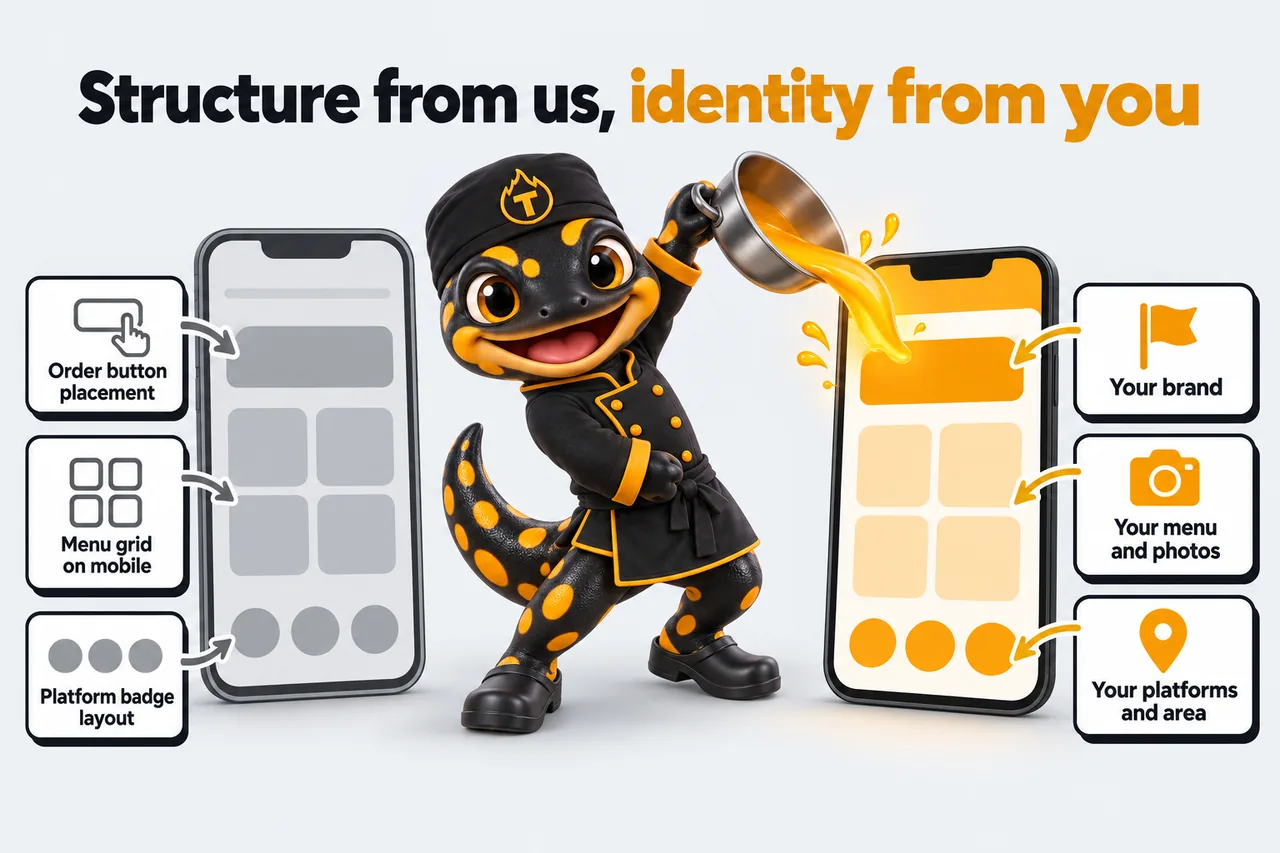
Starting from a template is the first step of the build, not the last one. Every page gets rebuilt with your menu, your real photography, your brand colors and type, your specific delivery platforms and your service area, so the finished site reads as yours and not as a shared layout with different logos dropped in. This is also where anything the template does not anticipate gets added, whether that is a second brand sharing the build, a pickup option the template did not originally include, or a catering add-on menu. The template is the scaffolding; the rebuild is the actual construction that happens on top of it before anything reaches a real visitor.
The speed advantage of a template comes from skipping the structural decisions, not from skipping the work of making a site look and feel like yours. That distinction is why The Line can launch in 7 working days: the layout logic, the mobile behavior and the ordering flow are already solved and tested, so the time goes into your content, your photography and your brand rather than into re-deciding how a menu grid should behave on a small screen. A rushed generic site and a fast, properly rebuilt site can launch on a similar timeline; the difference shows up in whether a visitor can tell your site apart from a competitor’s at a glance.
A template start works well for a brand-new site, but if you already have a site on another platform, the priority shifts to preserving what is working, your rankings, your existing content and any URLs customers or platforms already link to, while still getting the benefit of a proven structure underneath the new build. That migration work is handled differently than a fresh build, since the risk of losing existing search visibility has to be managed carefully during the switch. The commercial kitchen website redesign page covers how an existing site gets moved over without losing the ground it already earned in search.
A tested homepage and ordering layout used as the foundation, saving time on decisions that have nothing to do with your specific brand or menu.
Every color, font, image and word replaced with your own, so nothing generic survives into the finished site your customers actually see and order from.
Real menu content and photography built into the structure in place of any template placeholder, sized and compressed for fast mobile loading.
Ordering links and coverage set specifically to the delivery platforms and area you actually operate in, not a generic set left over from the template.
A mobile layout already proven across other kitchen sites, refined during the rebuild for your specific menu length and content requirements.
A full check confirming nothing generic or placeholder made it into the final, rebuilt site before it goes live to real customers.
What changed for these kitchen teams, in their own operational terms.
Order noteNo. 201
“The question 'who is answering this one?' used to hang over every commissary kitchen tours inquiry. Requests are assigned automatically, with a backup for when the owner is away. The website and our way of working finally match.”
Vasanth Wadhwa, Viewings administrator
Chocolate and patisserie kitchen hire, Akron, OH
Inquiry assignment and staff handover for commissary kitchen tours
Order noteNo. 202
“I wanted the commissary kitchen tours page to show how we work, not just assert that we work well. Everything published is material we reviewed ourselves, chosen because it answers a real question. Visitors arrive having already seen how we operate, which shortens the first conversation.”
Jamila Abbas, Client onboarding lead
Licensed commercial kitchen share, Ann Arbor, MI
Reference content and service presentation for commissary kitchen tours
Two comparisons that cover the alternatives most operators look at before commissioning this work. Both name the cases where the other option is the better fit.
No, the template is a starting structure for layout and ordering flow, not the finished design. Your color, type, photography, menu and platform links all get rebuilt specifically for your brand, which is what a visitor actually sees when they land on the page.
Yes, the menu grid structure is built to reflow cleanly whether you have ten items or sixty, and we adjust the grouping and layout during the rebuild if your specific menu needs a different structure than the default template assumes.
Anything specific to your operation, a second brand, a pickup option, a catering menu, gets added during the rebuild rather than forced into a structure that was not designed for it, so nothing important gets left out to fit a template.
Yes, you review the fully rebuilt site with your own content and branding in place before launch, and any adjustments happen as part of your included monthly revisions rather than as a separate paid step billed on top of the build.
The Line launches in 7 working days from the point your menu, photography and platform details are in hand, since the structural work is already solved going in and the time goes straight into your brand instead of layout decisions.
A live walk-through of the site you would get, in about 30 minutes. Plans from $117 a month, the $647 build fee invoiced only after launch, domain and hosting included.
Book a demoOr email and a person replies within one working day.
Everything on the pass
Book a demoSearch this site
Type to search every page and article. Press Enter for the full results page.
Appearance
Colour scheme
Accent
5 accents, all drawn from the same kitchen. Saved on this device only.
KitchenWebStudio uses the cookies below. Necessary cookies keep the site working and cannot be turned off.
Saved on this device only. Press Esc to close.