Prominent location display
A map or address block placed near the top of the page, not buried in the footer where visitors have to hunt for it before deciding to inquire.
A shared kitchen space website succeeds by removing ambiguity about where the facility is, what stations it has open, and how far the operation reaches, whether that is one location or several. A visitor deciding based on unclear location or coverage information walks away, so the site is built around location clarity as a first principle.
What it costs
A shared kitchen operation is judged on proximity and access as much as anything else: a caterer or food truck operator wants to know exactly how far the facility is from their usual service area before they inquire, and a delivery customer wants to know if a virtual brand operating out of that facility actually reaches their address. Burying the address and coverage area in a small footer line forces every visitor to dig for information that should shape their first impression of the page. A shared kitchen site needs the facility location, and any relevant coverage radius, visible near the top of the page a visitor lands on, not several scrolls deep into the homepage.
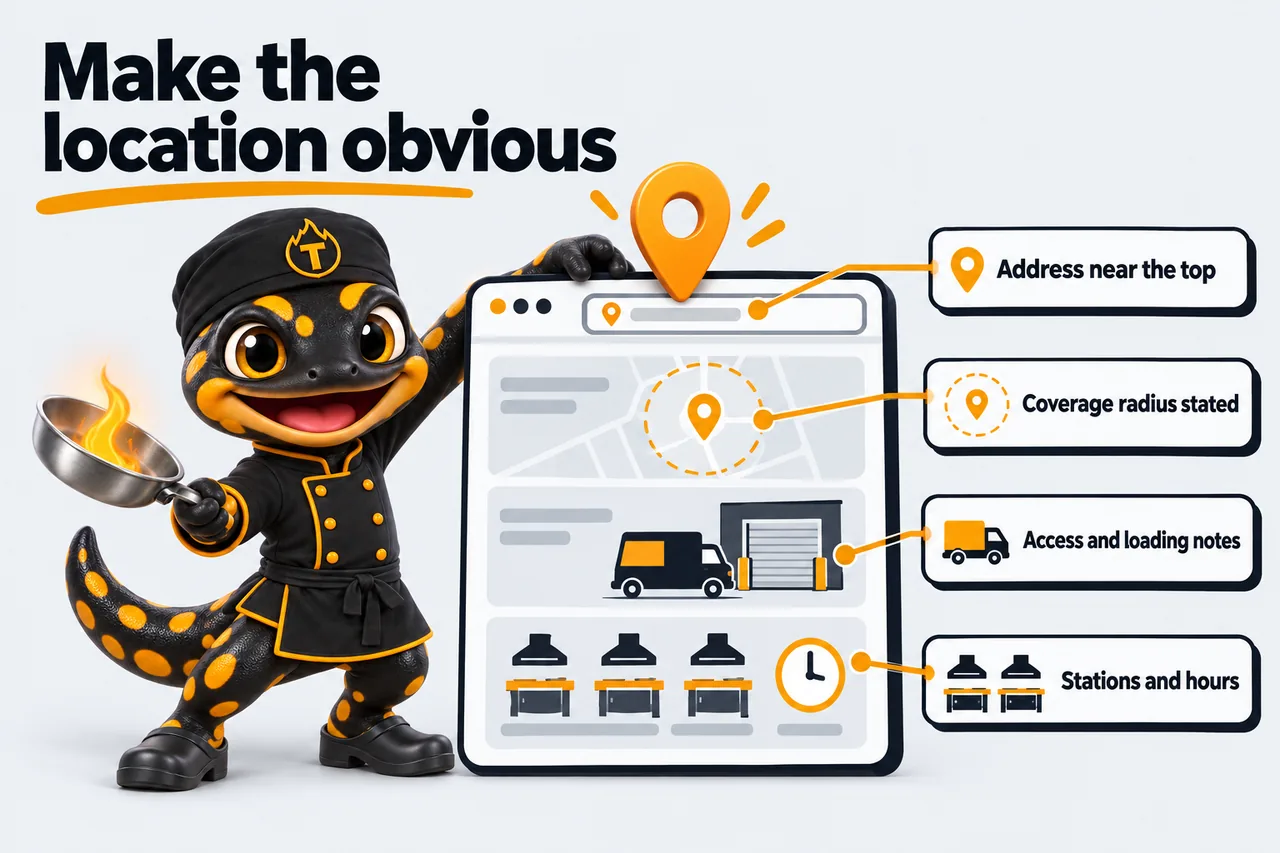
Practically, that means a map or clear address block placed prominently, delivery or service radius stated in plain terms rather than left implicit, and directions or access notes for anyone visiting the facility in person, whether that is a tenant touring stations or a supplier making a delivery. If the facility supports multiple access points or loading areas, that belongs on the page too, since a confused delivery driver or supplier is a real operational cost, not just a design nicety that looks unfinished. None of this needs to be visually heavy; a clean map embed and a few well-written lines usually do more than an elaborate graphic ever could.
A shared kitchen operation that grows to a second or third facility needs a site architecture that can hold multiple locations without confusing a visitor about which one they are looking at right now. Each facility gets its own page with its own address, stations, hours and inquiry routing, tied together under a shared brand and a simple way to switch between locations from anywhere on the site. Building that structure in from the start, even with a single facility today, avoids a painful restructuring project later when the second location actually opens and needs its own dedicated page added to the existing site.
Once a shared kitchen operation has more than one facility, the same architecture questions come up for any other multi-location kitchen business, catering companies included, and the underlying page structure and search strategy end up looking similar across both kinds of operations even though the buyer on each page is different. Both need a per-location page, a clear coverage statement and a way to route inquiries to the right contact without confusing a visitor who is only interested in the one location nearest to them. The multi-location catering website page covers how that same problem gets solved for a catering operation working across several service areas rather than several physical rental facilities like a shared kitchen runs.
A map or address block placed near the top of the page, not buried in the footer where visitors have to hunt for it before deciding to inquire.
Coverage area stated in plain, specific language instead of left for a visitor to guess at based on an address alone.
Directions and loading notes for suppliers and delivery drivers who need to physically reach the facility without confusion on arrival.
A dedicated page for each facility if the operation runs more than one, each with its own stations, hours and inquiry routing.
A simple way for visitors to move between facility pages without losing track of which location they are currently viewing on the site.
A check confirming every address, map and coverage claim is accurate before the site goes live to prospective tenants and customers.
What changed for these kitchen teams, in their own operational terms.
Order noteNo. 201
“The guided contact options looked like a small feature; they changed the inbox. New business and existing conversations now arrive under different subjects. Returning customers no longer repeat the whole form to ask one question.”
Beatrice Dalrymple, Customer care coordinator
Recipe development kitchen rental, Baton Rouge, LA
Inquiry categories and guided navigation for commissary kitchen tours
Order noteNo. 202
“Everyone talks about the new design; I cared more about where the old commissary kitchen tours links would land. The redirect plan was presented for our approval like any other deliverable. Not one 'your link is broken' message arrived after launch.”
Yvonne Fairchild, Tour appointments administrator
Food startup incubator kitchen, Plano, TX
Page migration and redirect mapping for commissary kitchen tours
Two comparisons that cover the alternatives most operators look at before commissioning this work. Both name the cases where the other option is the better fit.
Prominent enough that a visitor does not have to scroll or search for it. A map or clear address block near the top of the page removes the single biggest source of hesitation for someone deciding whether to inquire or visit in person.
Yes, if that better reflects how your facility operates, coverage can be stated as a radius or list of served areas rather than a single pin, as long as it is specific enough for a visitor to know if they are included in it.
Those can be included directly on the location section, covering loading areas, access codes or timing notes, since unclear access instructions create real operational friction on the ground, not just a confused website visitor scrolling for details they cannot find.
Yes, each facility gets its own page with its own stations, hours and inquiry routing, connected through a simple location switcher rather than mixed together confusingly on one shared page for every single location you happen to operate at once.
A single facility launches in 7 to 15 working days depending on plan; a multi-facility build takes longer per additional location, scoped during onboarding based on how many facilities need their own dedicated page and content from the very start.
A live walk-through of the site you would get, in about 30 minutes. Plans from $117 a month, the $647 build fee invoiced only after launch, domain and hosting included.
Book a demoOr email and a person replies within one working day.
Everything on the pass
Book a demoSearch this site
Type to search every page and article. Press Enter for the full results page.
Appearance
Colour scheme
Accent
5 accents, all drawn from the same kitchen. Saved on this device only.
KitchenWebStudio uses the cookies below. Necessary cookies keep the site working and cannot be turned off.
Saved on this device only. Press Esc to close.